
A lot of people who come to us for addiction treatment are carrying something else too — depression, anxiety, trauma, PTSD. Sometimes they know it. Sometimes they have never had a name for it. Either way, if a mental health condition is part of the picture, treating the addiction alone is not going to be enough. Dual diagnosis treatment in Baton Rouge at Red River Treatment Center addresses both at the same time — because that is the only approach that actually works for people dealing with both.

Dual diagnosis means you have a substance use disorder and a co-occurring mental health condition at the same time. The two are connected — often deeply. Mental health conditions can drive substance use as a form of self-medication. And prolonged substance use can create or worsen mental health symptoms. It goes both ways, and it feeds itself.
Common co-occurring conditions we see include:
You do not need a prior diagnosis to start treatment. At Red River Treatment Center in Baton Rouge, our clinical team screens for co-occurring conditions as a standard part of intake. If something is there, we find it — and we build it into your care plan from day one.
Here is something we see more than we would like: someone goes through addiction treatment, does the work, gets sober — and then the mental health symptoms come roaring back without the substance to mask them. And that becomes the trigger for relapse.
Or it goes the other way: someone gets mental health treatment, feels better for a while, but the substance use never gets addressed directly — and the cycle continues.
This is not a failure of effort. It is a failure of approach. When both conditions are present, treating them separately — or treating only one — leaves a gap that is very hard to stay sober across.
According to SAMHSA’s 2024 National Survey on Drug Use and Health, approximately 21.2 million adults in the United States had a co-occurring mental illness and substance use disorder. (1) That is not a rare edge case. It is the reality for a significant portion of people seeking treatment — and it is exactly why integrated care exists.

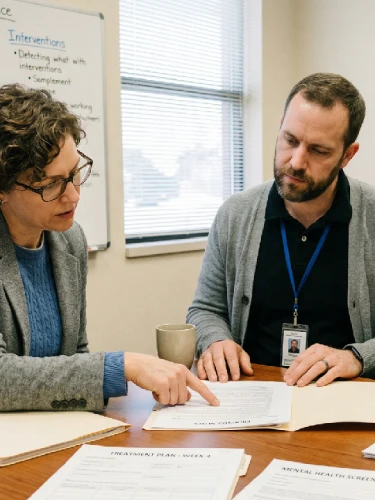
At Red River, dual diagnosis treatment is not a separate track. It is woven into the way we provide care across every level of the program.
Here is what that looks like in practice:
We meet you where you are. In Baton Rouge, our team has worked with patients across a wide range of life circumstances and co-occurring conditions. There is no judgment about what brought you here.
Practically speaking, dual diagnosis treatment does not look dramatically different from standard addiction treatment from the outside. What is different is the depth of what is being addressed inside the sessions.
Your daily programming will include:
The goal is not just sobriety. The goal is stability — mental and physical — that you can sustain after treatment ends.

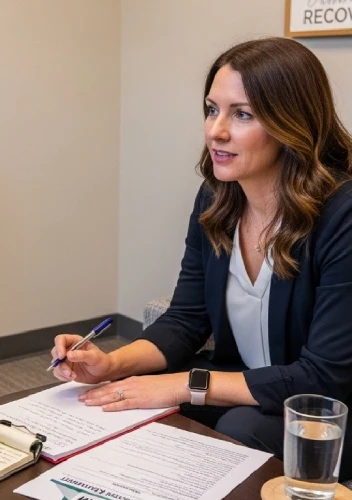
Finishing dual diagnosis treatment is not the end of the work. For most patients, it is the beginning of a more stable foundation than they have had in a long time.
Before you complete treatment, your care team will build a continuing care plan that accounts for both your addiction recovery and your mental health needs. That might include ongoing therapy, medication management, community support, or a step down into IOP or outpatient care. Learn more about integrated addiction and mental health care at Red River Treatment Center to understand the full continuum.
Long-term recovery with a dual diagnosis is absolutely possible. It just requires a plan that takes the whole picture into account. Contact us at (225) 443-4628 to take the first step.
Through a comprehensive assessment at intake. You do not need a prior mental health diagnosis — our clinical staff uses structured screening tools to identify co-occurring conditions as part of the admissions process.
Yes. Integrated care is part of how we operate at every level — detox, residential, PHP, and IOP. The mental health component does not disappear as you step down through the continuum.
The mental health conditions that we see most commonly co-occurring with addiction are:
That said, co-occurring conditions vary widely. A big part of your care team’s role is assessing your specific situation individually.
Yes. Dual diagnosis treatment involves clinical staff trained in both addiction and mental health care. You are not being handed off between two separate teams — it is one integrated plan.
Not necessarily more intensive — more complete. The structure and schedule are similar. What changes is the scope of what is being addressed and the depth of the clinical work. You can also view Red River’s Baton Rouge addiction treatment programs to get a fuller sense of what care looks like across the board.